
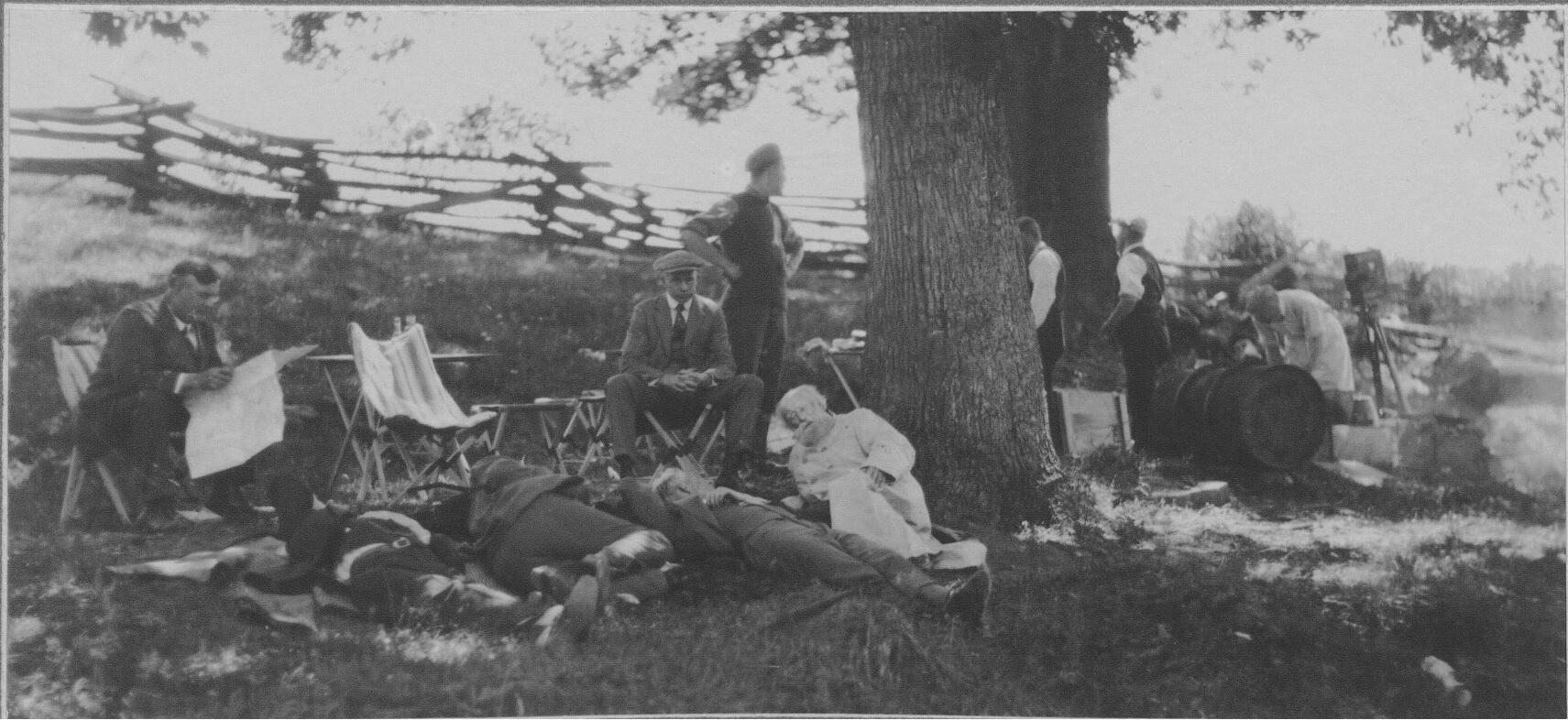
 Sometimes you just need to get away from work. It doesn’t matter if you are a leader of industry or someone who works for such a leader. In 1914, Henry Ford, Thomas Edison, Harvey Firestone, and John Burroughs discovered they got along well together and enjoyed each other’s company. They started making plans for summer vacations where they would travel around the country in cars Ford’s company built by Ford on tires Firestone’s company manufactured.
They called themselves the Vagabonds.
Over the years their meeting, they got together to travel along the East Coast and into the Midwest. Their stops included New England, West Virginia, North Carolina, Michigan, Tennessee, Virginia, Massachusetts, and Maryland. They seemed to favor mountain settings like the Appalachians, Catskills and Adirondacks.
Although the Vagabonds camped out during these road trips, they weren’t roughing it on these trips by any stretch of the imagination.
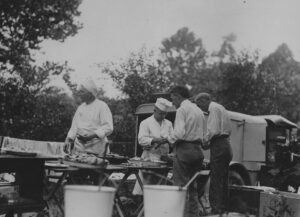
According to The Henry Ford Foundation, “The 1919 trip involved fifty vehicles, including two designed by Ford: a kitchen camping car with a gasoline stove and built-in icebox presided over by a cook and a heavy touring car mounted on a truck chassis with compartments for tents, cots, chairs, electric lights, etc. On later trips, there was a huge, folding round table equipped with a lazy susan that seated twenty.”
Household staff traveled with the men to cook, clean, and pack for them. Ford Motor Company photographers also accompanied the group to document the events.
Nowadays, this would be called glamping, which is camping, but with the luxuries of home.
One of the Vagabonds’ early trips passed through Garrett County with a mid-day stop near Oakland to rest and eat. Their itinerary for the day started on Summit Mountain in Pennsylvania. They made a quick stop in Keyser’s Ridge to pick up mail and then headed south through Garrett County, passing through Oakland on their way to Horse Shoe Run, where they made camp for the night.
In 1921, however, changes happened with the Vagabonds’ trip. The first change was that the four vagabonds became three with the death of naturalist and writer John Burroughs on March 29, 1921. Firestone, Ford, and Edison decided they would still vacation, but they would find a way to honor their friend.
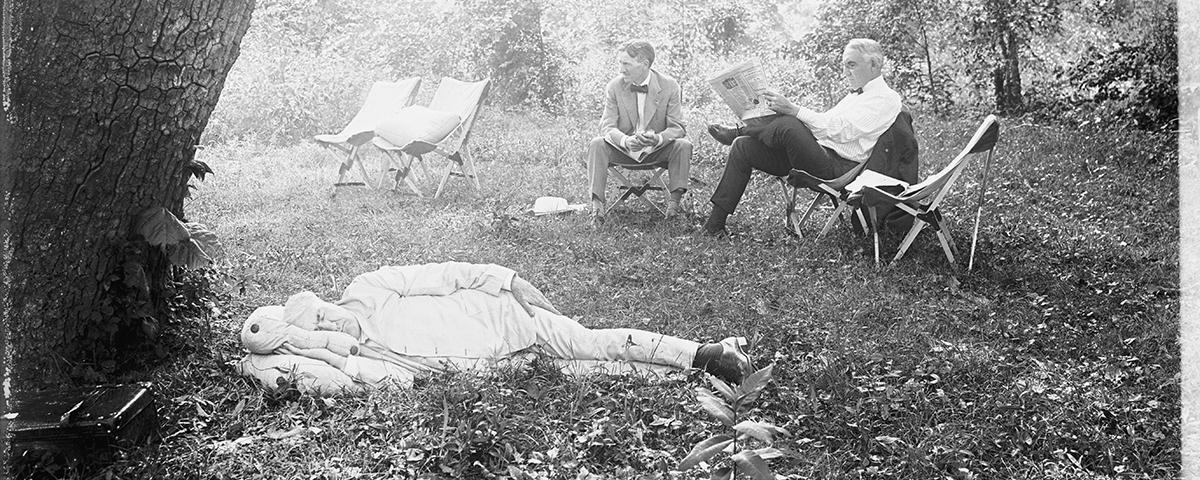
They decided to include an honorary Vagabond, not to replace Burroughs, but simply to have another notable person camping with them. This honorary Vagabond turned out to be President Warren G. Harding.
Firestone and his friend, Bishop William F. Anderson of Ohio, visited President Harding at the White House and invited him to join the camping trip in late July. Harding and Firestone were longtime friends. The President accepted, but he needed the camping trip to travel within a reasonable driving distance of Washington, D.C. in case he might be needed in the capital city quickly.
“Unfortunately, during the week of July 17, Mrs. Harding became ill, and the President had to delay his rendezvous with the campers for several days, until he was certain his wife was in no danger,” the Model T Times reported.
Harding wouldn’t be able to accompany the Vagabonds on the entire trip, but he would camp with them on July 23, 1921, near Licking Creek in Maryland. The area is now called Camp Harding County Park in Washington County, Maryland, and a plaque there commemorates the location of the campsite.
Another change was that the men included their wives on the trip, something to which Edison objected. “Edison was concerned that the wives would not ‘appreciate the primitiveness of camp conditions or take pleasure in roaming over the unbeaten track,’” according to Model T Times.
The change that was most important to Western Maryland is that instead of traveling all day and camping for a single night at each stop, they decided to actually enjoy the camping as well as the traveling. They extended their stay at two Western Maryland campsites before traveling into West Virginia.
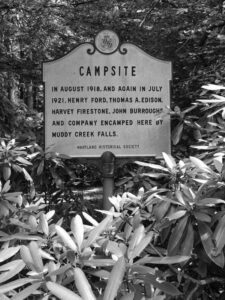
From July 22 to July 27, the Vagabonds camped on Licking Creek near Pecktonville in Washington County. Following this stop, they camped from July 27 to July 31 near Muddy Creek Falls in McHenry.
On July 21, Ford and his wife, Clara, sailed from Detroit, Michigan, to Cleveland, Ohio, along Lake Erie on their yacht. They met Firestone in Akron, Ohio, and traveled to the Firestone homestead in Columbiana, Ohio, to meet up with Harvey Firestone, Jr. and his new bride, along with Firestone’s other son, Russel.
The Fords’ son, Edsel, and his wife also visited the homestead. The Women’s Missionary Society of the Grace Reformed Church served the group dinner. From there, they drove to Bedford Springs and spent the night. The next day, the Fords and Firestones drove to Hagerstown where they met the Edisons, who had arrived from West Orange, New Jersey, and Anderson and his wife, who arrived from Washington, D.C.
They ate lunch there, and then the group went to Pecktonville, near Big Pool. They set up camp along Licking Creek on a 200-acre farm. “The camp was quite elaborate with numerous tents and nearly fifty cots for sleeping,” the Model T Times reported. “A special electric lighting system was erected and even a large truckload of food from the Firestone farm arrived, which contained two refrigerators with several hundred pounds of meat, butter, eggs, milk, melons, and one hundred dressed chickens. All the meals were prepared by Chefs Fisher and Herman. There was also a special padded truck which brought six of Firestone’s finest riding horses all the way from Akron.”
Edison thought all the preparations were too extravagant. He liked his camping to be more rustic. “Ford and Firestone quickly reminded him that he had contributed to the setup with his special electrical lighting equipment and a portable radio, which was a rare item in those days,” the Model T Times reported.
After the evening campfire conversations, the entire group retired early to get a good night’s sleep to prepare for the arrival of President Harding the next day.
President Harding becomes a Vagabond
Henry Ford, Thomas Edison, Harvey Firestone, and John Burroughs were friends who enjoyed traveling and camping together in the early 1900s. They called themselves the Vagabonds. However, in 1921, Burroughs died, leaving an empty spot among the group.
Firestone and President Warren G. Harding were longtime friends. Firestone invited the President to join the Vagabonds on their trip. Harding accepted, but he wasn’t able to accompany them on their entire trip. Instead, he said he could join them on July 23 at their campsite near Licking Creek. The area in Washington County is now called Camp Harding County Park.
“Selection of Harding to take the vacant place in this camping club of distinguished men is considered one of the most unique honors conferred since he became President,” the Frederick News reported.
The President left Washington, D.C. at 9:30 a.m. He must have been eager to get away overnight because he averaged fifty miles per hour on the trip there.
“The Secret Service and the many journalists and photographers had difficulty keeping up with the President’s car as it journeyed toward Funkstown,” according to The Model T Times. “He arrived shortly after Ford, Firestone, Edison, and company arrived.”
They arrived at the campsite on Licking Creek around 1 p.m. The group ate lunch in a dining tent with at a table that had a lazy Susan that had a nine-foot diameter.
After lunch, the men enjoyed a casual afternoon. The President took a nap in his tent. Ford and Firestone competed in a wood-chopping contest. Edison laid down under an elm tree and took a nap.
When Harding woke up, he, Ford, and Firestone went horseback riding. Harding’s personal secretary, George Christian, and Secret Service agent, Colonel Edmund Starling, accompanied them.
“The President then visited a local general store and made a phone call back to the White House to check on the health of his wife,” the Model T Times reported. “While there, he bought candy for several local children gathered at the store.”
Back at camp, the group enjoyed a hearty dinner. Music was provided by a player piano powered by a portable electric generator. The Vagabonds stayed up to 2 a.m., talking and telling stories around a campfire.
The following day, the group went horseback riding after breakfast.
After the ride, Bishop Anderson held a Sunday morning worship and memorial service in memory of Burroughs, one of the original Vagabonds.
“Mrs. Firestone played the piano and the congregation sang hymns,” the Model T Times reported. “There were several hundred in attendance, as many local farmers and visitors joined the service. The service concluded with the audience joining President Harding in singing ‘Rock of Ages’ and ‘Nearer My God to Thee’.”
They lunched at the campsite, and Harding and his entourage left around 4 p.m. to return to Washington. It had been a quick getaway for Harding, but the trip was only beginning for the remaining Vagabonds.
 The Vagabonds in Garrett County
Henry Ford, Thomas Edison, Harvey Firestone, and John Burroughs were friends who called themselves the Vagabonds. They enjoyed traveling and camping together in the early 1900s until Burroughs died in 1921. President Warren G. Harding took Burroughs’ place for one night during the Vagabonds’ 1921 camping trip, but he couldn’t continue with the group as they traveled west from Washington County into Allegany County.
Harding spent July 23 with the group, and then headed back to Washington, D.C. late afternoon of the next day. On July 25, the remaining Vagabonds began planning their next destination while still enjoying the campground along Licking Creek in Washington County.
On July 27, they broke camp, made their way to the National Road, and headed west toward Garrett County. They stopped for lunch in a field near Deer Park and then moved on to the Swallow Falls area.
“It is said that Fred W. Besley, Maryland’s first forester, recommended Swallow Falls for the campsite. A fortunate choice it was, too. This is probably the most scenic region of Maryland,” Caleb Winslow wrote in Journal of the Alleghenies.
The campsite was an area filled with virgin hemlock and fir trees, but to get to it, they had to cross a small wooden bridge.
“The first cars made it across, but the bridge collapsed under the weight of the heavy camp kitchen truck and blocked the path of the remaining vehicles carrying the supplies,” the Model T Times reported.
Members of the group had to carry the supplies to an open clearing near Muddy Creek, the highest natural waterfall in Maryland. It was a perfect campsite.
Unfortunately, they weren’t the only ones to think so. They found a group of young boys from Oakland had already camped there.
According to Joseph Hinebaugh, who was a boy in the group, Ford paid the boys to move to a different campsite. “The boys visited the famous campers several times and eagerly accepted candy and other treats,” according to the Model T Times. “They had the opportunity to inspect the method the ingenious Edison used to illuminate the camp by obtaining electrical current from the batteries of the automobiles for the light bulbs strung around the tents.”
After a long day of travel and a lot of physical work hauling supplies, the Vagabonds and their entourage went to bed early and slept late the next morning.
They relaxed on July 28, and the broken bridge kept visitors away from the area who might want to see the famous trio. This gave the men some relative seclusion. The men swam in the creek and around the waterfalls. They hiked trails in the area. Edison, in particular, enjoyed sitting by the falls and relaxing.
“Ford enjoyed hiking the back roads looking for anything old or mechanical,” the Model T Times reported. “He discovered an old steam engine at a nearby sawmill and wanted to purchase it.”
Newton Reams, who owned the steam engine, visited Ford at the camp. According to Reams, Ford reached into his pocket and paid for the engine with two $50 bills. Ford examined the engine and asked Reams if he could find a missing part.
Reams went to a neighbor who had a similar engine and asked to buy the part. The neighbor would only sell the entire engine, and he wanted $75. Reams told Ford he would need to buy an entire second engine to get the missing part.
“How much?” Ford asked.
Reams doubled the price. Ford again reached into his pocket and pulled out three $50 bills. Reams took both engines to Oakland and shipped them by train to Dearborn, Michigan, while pocketing a nice profit for his work.
During their stay, Ford’s Lincoln automobile got stuck in the mud, and a resident hooked his horses to the car to pull it out.
A young boy, not knowing who Ford was, allegedly said, “Mister, you have the wrong kind of car. My father drives a Ford, and it never gets stuck on this road.”
Ford delighted in the testimonial. He wrote the name and address of the boy’s father, and when he returned home, sent the man a brand new Model T.
Henry Sines and his brother, Abraham Lincoln “Link” Sines, spent time at the Vagabonds’ camp. The brothers shared stories about the area with the group. Link was a forest warden and master woodsman. He had met the Vagabonds, including John Burroughs, in 1918, when they passed through Garrett County. Now with Burroughs gone, Link served as a guide and naturalist for the Vagabonds.
Link later wrote about how the Vagabonds spent their time. “Ford loved anything mechanical. He was constantly looking for items to add to his collection in Detroit. Firestone liked to fish. Edison was either reading a book or tinkering with his Packard. Burroughs knew more about trees and plants than anyone I ever met.”
Once, R. Emerson Cross and his friends rented horses in Oakland and rode into the Vagabonds’ camp while they were riding in the Muddy Creek area. The Vagabonds asked if they could borrow the horses to ride. Cross agreed, and when the Vagabonds returned from their ride, they gave Cross and his friends $30. Cross was delighted, since they only paid $1.25 each to rent the horses.
Leaving a legacy behind
In 1921, Henry Ford, Thomas Edison, Harvey Firestone, and their entourage camped near Swallow Falls in July. The men had been taking summer camping and driving trips since 1918, though this was the first year they had done it without the fourth “Vagabond,” John Burroughs.
Despite an early mishap with a collapsed bridge on their way to the campsite, the men enjoyed their time in Garrett County, hiking and swimming. As their time in the county came to an end, they had to decide where to venture next. It was decided they would visit the Cheat River in West Virginia.
However, on July 30, when they were scheduled to break camp, a severe rainstorm hit the area and soaked the area for hours. The road leading out of the campsite became impassable because of mud, and the group had to remain another day. This gave the ground time to dry out somewhat so their vehicles wouldn’t get stuck in the mud as they made their way back to the road. Even with the delay, some of the vehicles had problems. A big truck that carried the camping equipment got stuck and had to be pulled out by a tractor while the other vehicles continued.
The group spent the night of July 31 in Elkins, but since the truck with the camping gear hadn’t arrived, they spent the night in a hotel instead of tents. They made it to the Cheat River the next day, but then had to start their journey home because of both Ford’s and Firestone’s offices had been trying to find out when they would return to deal with business issues.
The return journey went through Fairmont, Morgantown, and Uniontown, where they stayed at the Summit Inn. That evening at the Summit Hotel, Edison showed off his agility by kicking a cigar off the mantle in the hotel lobby three times in a row. He and Ford competed in a “stair jumping” contest on the lobby stairs. Ford jumped up ten steps in two hops. Edison needed three hops to jump the same ten stairs.
From Uniontown, the group went to Pittsburgh, where the Vagabonds went their separate ways to return home.
The Vagabonds’ camping trips continued until 1924. At that point, the men were too well known to go camping and enjoy their leisure time, undisturbed by the public.
In 2018, a special tour was held to commemorate the centennial anniversary of the first August 1918 Vagabonds camping trip, which also included a stop in Garrett County for lunch. The tour began at the Summit Inn near Uniontown and retraced the Vagabonds’ trip on the same dates as the original trip.
Today, a Maryland Historical Society Marker in Swallow Falls State Park shows where the Vagabonds made camp while in Garrett County.