
The crime
On April 30, 1912, William Reed was executed for a murder he never denied committing.
The forty-two-year-old Reed had a reputation as an honest and hard laborer. More importantly, he didn’t have a record as a troublemaker, but on May 9, 1911, he had been drinking on and off for a couple of days and had finally come to decision. He took the train from Waynesboro, Pennsylvania, to Mont Alto, Pennsylvania.
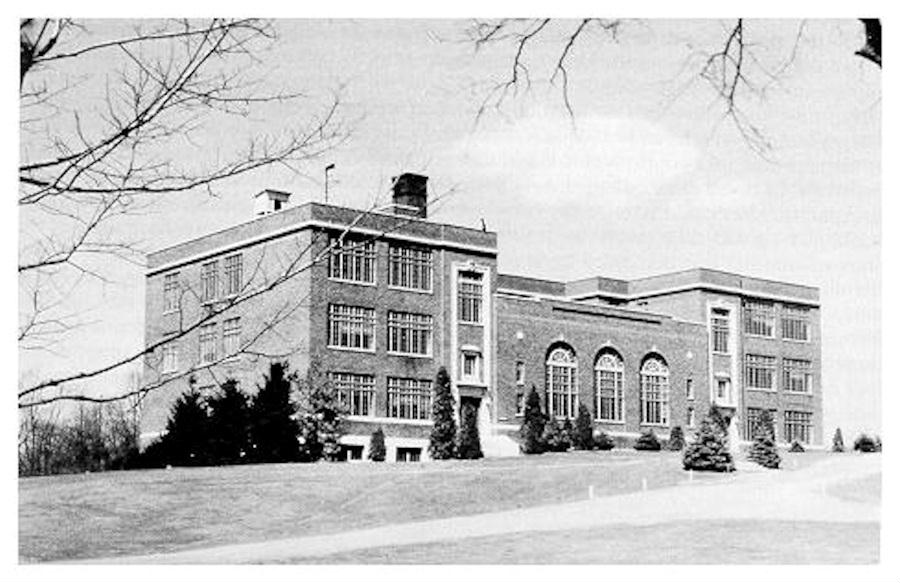
Pennsylvania State Forest Academy at Mont Alto. Courtesy of Wikimedia Commons.
The Pennsylvania State Forest Academy in Mont Alto was one of the first forestry schools in the country, established by the governor of Pennsylvania in 1903. Today, it is Penn State’s Mont Alto Campus.
Reed had worked at the academy for a short time in 1907, and it was there that he met Sarah (Sadie) Hurley Mathna. She was a single mother whose husband had abandoned her, leaving her struggling to get by. She couldn’t even afford to raise her daughter Della. The eight-year-old was living with friends of Mathna’s in Guilford.
Reed and Mathna had taken a liking to each other and moved in together for about a year between 1908 and 1909. They split up when Mathna moved to Chambersburg to work in the Miller Hotel, while Reed worked as a laborer for different businesses in Waynesboro. They still saw each other on weekends, but they began drifting apart, or at least, Mathna began considering ending the relationship.
She eventually returned to Forest Academy to work in the kitchen, and it was there that Reed found her on May 9. By the time he arrived, breakfast was finished, and there was no one else in the kitchen except for Mathna, who was grinding coffee.
What was said between the two of them is not known. Only Reed was around later to give his version, which was that he asked Mathna for some papers and pictures there were his. She gave him some of them, but she told Reed that she had burned the rest of the papers and pictures. This is what Reed said enraged him.
He drew his .38 caliber revolver and fired three shots, hitting Sarah in the neck, the cheek, and the chest. It would later be found that the last bullet pierced her heart and was the fatal shot.
The academy matron, Sarah Conklin, came running from the garden when she heard the shots. Another woman who helped in the kitchen, Margaret Brickers, was at the road buying bread from a baker’s wagon when she heard the shots.
George Miley, the baker who was selling the bread to Brickers, saw Reed shoving a revolver in his pocket as he came out of the kitchen.
“I have just shot Sadie and have done for her,” Reed told Miley.
Inside the building, Mathna had staggered out of the kitchen and collapsed on the floor in the dining room.
The group that found her there carried her upstairs to a lounge. She said nothing but “gave several gasps and died,” according to the Public Opinion.
Reed just kept walking toward Mont Alto. Along the way, the wife of a doctor in Mont Alto approached him.
“Passing Mrs. Brosius at the latter’s [house] she asked what was wrong at the Forestry School and he replied in a laughing way, easy in manner and very cool, ‘My girl is sick’ and passed on,” reported the Public Opinion. Reed would deny saying this during the trial.
He found his friend Romaine Small in town and told him, “Well, she’s dead! I’ve shot Sadie and I’m going to give myself up!” Then Reed walked to the Constable Jacob Wile’s office. He explained what had happened and surrendered.
Throughout all the events following the shooting, Reed appeared “perfectly cool and calm,” according to the newspaper.
While sitting in county jail awaiting trial, the Public Opinion interviewed Reed. He said, “I didn’t go there to kill here. I went there to get some of my letters and pictures. We had some words. I pulled out my revolver and began firing to scare her. The shooting of the revolver was no accident. I don’t know why I shot her. I lost my head. You know how it is when you get mad.”
Following the coroner’s inquest, Mathna’s body was taken to Roxbury. Services were held in the United Brethren Church, and she was buried there.
The punishment
William Reed had shot and killed Sarah Mathna on May 9, 1911. That was not in doubt. Even Reed admitted it. However, the real question that the Franklin County jury had to determine was whether Reed had gone to the State Forestry Academy in Mont Alto intending to kill Mathna or whether he had temporarily lost his senses when he killed her.
Attorneys J.W. Hoke and Irvin C. Elder began laying out their case to save Reed’s life on September 7, 1911. They were opposed by District Attorney D. Edward Long who told the jury that Reed had committed premeditated murder. After three days of testimony, the jury retired at 4:42 p.m. on a Saturday and returned a verdict of guilty of murder on Sunday at 7 p.m. The difficulty in reaching a decision can be seen in the fact that it took 14 ballots to reach a decision.
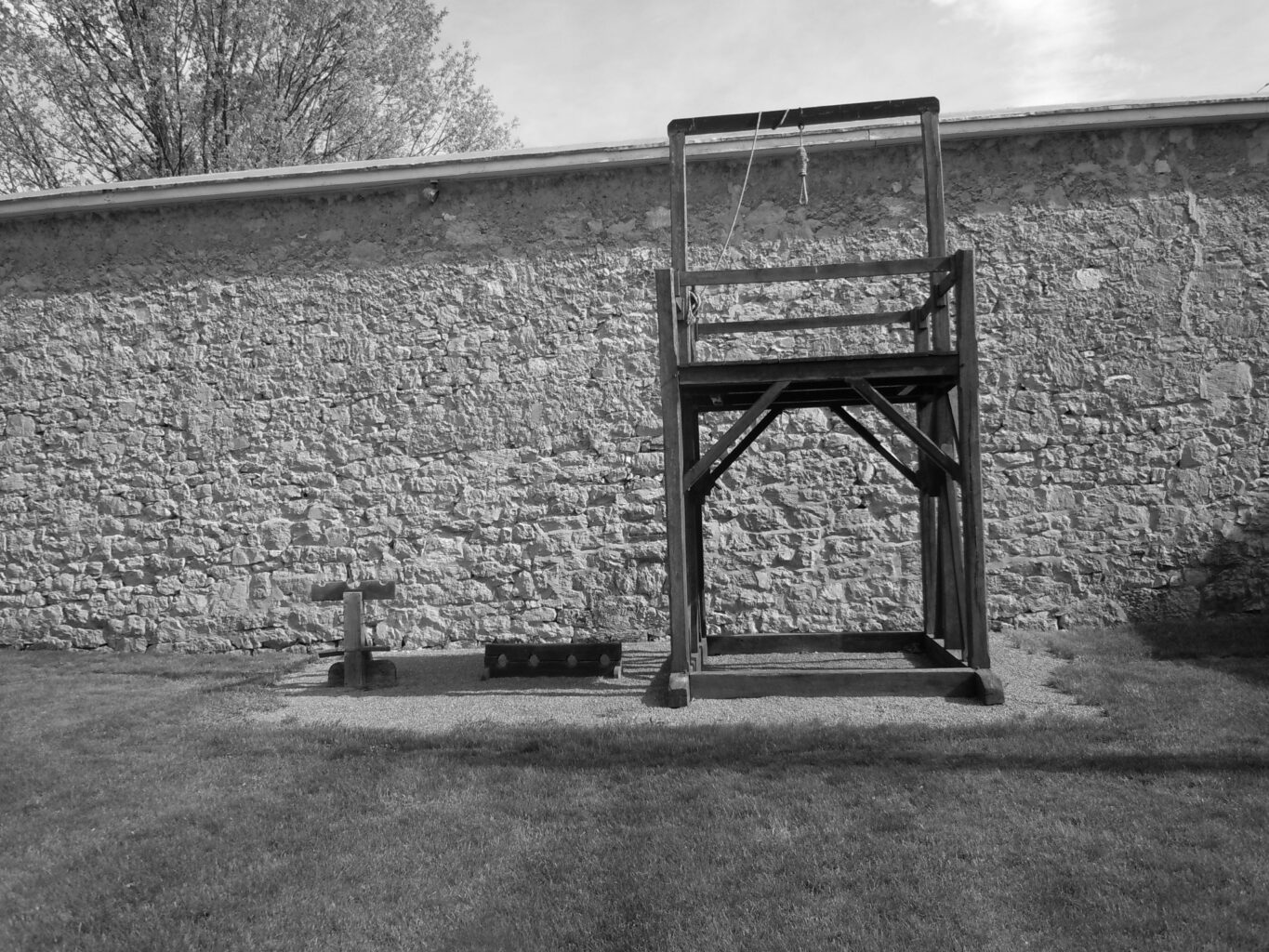
The old gallows at the Franklin County Jail. Courtesy of the Franklin County Historical Society – Kittochtinny.
Reed was sentenced to be hanged by the neck until dead.
Under state law, death sentences were automatically appealed at the state level. Reed was kept in the women’s quarters of the county jail during this time so that he was separate from the other prisoners. His cell was on the second floor on the west side. The sheriff also set a death watch on him while he awaited his appeal.
During his months-long wait in the jail, passersby got used to seeing Reed’s face in the second-floor window. The school children took to calling it “Reed’s Window,” according to the Public Opinion.
When Reed’s appeal failed to overturn his death sentence, his execution was scheduled.
“On the day before his death, it is said he called out the window to some boys something to the effect that he was to be hanged the next day, but had one more day to live. He held up one finger to at least one man who passed, indicating that but one more day on earth was left to him,” the Public Opinion reported.
If this troubled Reed, he didn’t show it. He slept well the night of April 29.
On Tuesday morning, April 30, “The day was gloomy, rain drizzling, it was cold and penetrating and added to the depression of the little band assembled inside the canvas enclosure waiting for the most dreadful sight in human possibilities to witness,” according to the newspaper.
Reed had no special request for his last meal. He dressed himself in a black suit with a striped white shirt and “blue four-in-hand tie and low collar.”
Before the appointed hour, he accepted a visit from Rev. W. C. Cremer. The clergyman held a special service in Reed’s cell that morning.
As Reed was led from his cell, his last words were, “I thank all my friends and everybody who has expressed sympathy for me. I am sorry for my deed. I forgive everybody and hope all will forgive me for anything I may have done to others.”
Outside the jail, crowds had been forming on King and Second streets to see the first hanging in Franklin County in thirty-three years. “Points of vantage on trees, poles and roofs near the jail had men and boys perched thereon,” the newspaper reported. The police tried to keep the crowd moving, but they simply circled the block and returned. Children who were in the school next door were kept inside and away from the windows.
Reed appeared at the back of the jail at 10 a.m. with Sheriff George Walker and Deputy Ellsworth W. Kuhn. They walked across a gangway from the back porch of the jail to the gallows. Even facing death, Reed appeared calm as he glanced down at the fifty or so people who had been allowed into the courtyard to witness the execution.
He walked steadily “as if promenading the streets,” the newspaper reported. He stopped on the trapdoor.
The sheriff placed the noose around Reed’s neck and then a black cloth bag over his head. Walker pulled the knot tight behind Reed’s left ear and Reed grunted as if it had hurt him. Kuhn bound Reed’s ankles together while Walker cuffed Reed’s hands behind his back.
Walker stepped back to the lever, glanced at Kuhn, and pulled it at 10:06 a.m. The trapdoor fell open and Reed dropped about six feet. It was reported that he had no pulse about a minute later, though his heart continued beating. Dr. J. H. Devor and Coroner J. P. Macay pronounced Reed dead at 10:16 a.m.
“If it is the right idea to instill in human minds a fear to commit murder by making the law’s vengeance horrible and fearsome through capital punishment, then it seems to us that hanging is the way to effect the purpose. Staring with eyes wavering through innate repulsion at that instrument of death which by right takes equal rank with those of the inquisition one could not well conjure a punishment more debasing or more to be dreaded by man,” the Public Opinion reported.
Reed’s body was taken by train to Mont Alto later that day and the last person to be hanged in the county was interred beside his parents.