
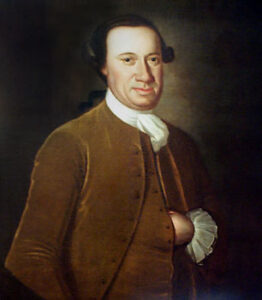
 While it’s not so much a secret that John Hanson, a resident of Frederick City, MD, was the actual first president of the United States, what was literally a secret for decades was where his final resting place was located.
Most people consider George Washington the first President of the United States, and he was. He was elected the first president of the country governed by the U.S. Constitution in 1789.
However, between the signing of the Declaration of Independence and ratification of the Constitution, our brand new country was governed by the Articles of Confederation. It was the colonists’ first attempt at creating a national government that would govern over the states in a fair manner.
Once in place, the Articles of Confederation showed its shortcomings, such as creating a weak federal government that interfered with states’ abilities to conduct foreign diplomacy. This led to the Constitutional Conventions and the creation of the Constitution.
The head of the government under the Articles of Confederation was also called the president, although he was actually the president of Congress, which was largely a ceremonial position, according to the National Archives. However, he was the person who had to sign the official documents for the country.
On November 15, 1781, a small notice ran in the Annapolis Gazette that read, “On Monday last, pursuant to the articles of confederation, a sufficient number of delegates for the States having met, the United States in Congress assembled proceeded to the choice of president for the ensuing year, and the ballots being taken, the honourable JOHN Hanson was elected.”
Although Hanson was the first leader of the United States, his office was so weak that this announcement wasn’t even major news. It ran at the bottom of page 2 of the newspaper.
Hanson was born in Port Tobacco Parish, Charles County, in 1715, but he moved to Frederick City in 1769, to work as a deputy surveyor. He lived at a house near the intersection of Patrick and Court streets. In 1771, he also became the sheriff of Frederick County, according to the MD250 website. He chaired the Frederick County Committee of Observation and was also elected as the county treasurer.
He was a delegate to the Continental Congress from 1780 to 1782. It was during this time that he signed the Articles of Confederation as part of the Maryland congressional delegation. This led to his election to the office of president in November 1781.
“One week later he considered resigning from this position because of poor health, family responsibilities, and the ‘irksome’ qualities of the ‘form and ceremonies’ required as president,” according to the MD Two Fifty website.
He was convinced to remain and serve out his term until November 4, 1782. During his time in office, a consular service was established, a post office department created, a national bank chartered, a uniform coinage system adopted, established Thanksgiving Day as the fourth Thursday in November, and made movement toward taking the first national census, according to the Architect of the Capitol.
Hanson died on November 15, 1783, at the age of 68, in Oxon Hill, MD.
And this is where the mystery begins.
Following Hanson’s death, his body was interred in a crypt on his nephew, Thomas Hanson’s Oxon Hill Manor. In 1808, the Addison Family created its cemetery just 400 feet from Hanson’s crypt at Oxon Hill Manor. Two years later, the Addisons sold Oxon Hill Manor to the Berry Family, though they retained the rights to continue using the cemetery, according to johnhansonmemorial.org. The last known burial in the cemetery was made in 1871.
When Oxon Hill Manor went into receivership in 1878, the four bodies in the crypt were moved to the Addison family cemetery.
According to johnhansonmemorial.org, by the 1930s that re-interment was forgotten since it had been done privately, and Hanson’s gravesite was unknown. For decades, Hanson remained the only American president whose final resting place was not known.
In 1985, according to johnhansonmemorial.org, a state survey located the crypt where Hanson had originally been buried. The survey noted it was intact and sealed. However, two years later, an archeological survey found the crypt empty.
Not knowing the bodies had been moved a century earlier, the initial belief was that the graves had been robbed and that John Hanson’s body had disappeared.
Oddly, the crypt even disappeared. A 1993 photo of the property where the crypt should have been didn’t show it.
Then, in 2017, all the remains from the Addison family cemetery were re-interred at St. John’s Episcopal Church graveyard in Fort Washington, Maryland. This proved lucky because the Smithsonian Institution took the opportunity to do a forensics examination of the remains.
 According to johnhansonmemorial.org, “[Peter] Michael’s records of the Smithsonian Institution 2017 forensics examination of 40 sets of remains from Addison Cemetery reveal a solitary unidentified elderly male who can only be John Hanson.”
Further, Peter Michael and Mark Kennedy pooled their research on Hanson in 2024 and used a chain-of-title for the land records of Oxon Hill Manor to rediscover that Hanson had been re-interred to the Addison family cemetery in 1878.
The lost president had been found.
Today, a reconstruction of Hanson’s house can still be found at 100 W. Patrick Street in Frederick. The original building had been listed on the National Register of Historic Places in 1971, but it was demolished in 1981. It was removed from the National Register of Historic Places and the reconstructed building was added.
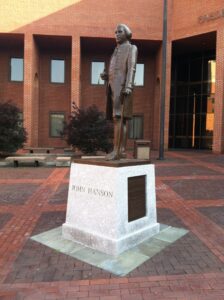
A national memorial statue of Hanson stands outside of the courthouse on West Patrick Street.