
 Most people wouldn’t think of Frederick County as a place where revolution was fomented. It is often forgotten amid other places like Boston and Philadelphia.
However, when the British Parliament passed the Stamp Act in 1765, the American colonists were not happy when the news reached them. The Stamp Act revenue was supposed to finance the costs of keeping British troops in North America. It was the first internal tax levied directly on American colonies. It required all official documents in the colonies be printed on a specially stamped paper.
The news of this tax reached Maryland in May 1765, when the text of the act was printed in the Maryland Gazette. Newspapers like the Gazette opposed the act because they also would have to be printed on the taxed paper, increasing their costs.
The stamped paper arrived in Maryland in October 1764, shortly before the act was to take effect November 1. Mike Maharrey wrote in a Tenth Amendment Center article that between May and October the citizens’ anger over the Stamp Act had “reached the point that Gov. Horatio Sharpe was afraid the colonists would destroy the paper if it was offloaded. He requested that the stamped paper remain onboard the ship until the situation cooled off. As a result, when Nov. 1, the effective date of the Stamp Act rolled around, there was no stamped paper available in the Maryland colony.”
In mid-November 1764, 12 magistrates of the Frederick County court ordered a man to be released on bail and directed court clerk John Darnall to draw up the paperwork for the court. With no official stamped paper available, Darnall said that his office couldn’t conduct any official business until it received the paper, essentially bringing legal and commercial business to a halt in the county.
The magistrates ordered him to continue without the stamped paper. When Darnall refused, he was found in contempt of court and jailed. After a night in jail, he said he would comply, paid a fine, and was released.
On Nov. 23, the magistrates unanimously ruled that the Stamp Act would be ignored. The stated two reasons for this decision were: 1) There had been no formal notice of the act’s passage and implementation, and 2) It was impractical to halt all business in the county because no stamped paper was available.
Their ruling read, in part: “It is the unanimous resolution and opinion of this Court that all business thereof shall and ought to be transacted in the usual and accustom manner without any inconvenience or delay to be occasioned from the want of stamped paper, parchment of vellum and that all proceedings shall be valid and effectual without the use of stamps, and they enjoin and order all sheriffs, clerks, counsellors, attorneys and all officers of the court to proceed in their several avocations as usual which resolution and opinion are grounded on the following reasons.”
This was the first act of revolt against the Stamp Act, and it was done by simply ignoring it.
Some historians believe this act of repudiation was actually a bit of theatrics.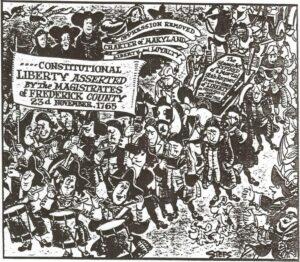
“Darnall had served in that capacity as court clerk since the founding of the county in 1748. One of the sitting magistrates for the November 1765 Court Term was James Dickson, who was Darnall’s son-in-law. As Millard M. Rice points out in his book This Was the Life, a careful reading of the court proceedings prior to Nov. 18, 1765 shows no evidence of anyone at the Frederick County Court having a concern about conducting legal business without the Stamp Act paper. The justices selected one seemingly insignificant case on which to make their ruling. The justices refer to ‘this Province,’ implying an expansion beyond the boundaries of Frederick County, and an indication there may have been others, at a higher level of government, involved in formulating the decision. One can speculate the justices, besides seeking an opportunity to snub the Stamp Act, also were providing Darnall some political cover by ‘forcing’ him to accept the court’s ruling,” Ryan Bass and Pat Barron wrote in their article “Repudiation of the Stamp Act.”
The 12 magistrates who defied the law have become known as “The Twelve Immortals.” They are: Thomas Beatty, Peter Bainbridge, Josiah Beall, Samuel Beall, William Blair, James Dickson, Andrew Heugh, Charles Jones, William Luckett, David Lynn, Thomas Price and Joseph Smith.
A week after they took their stand against unfair taxation, the people of Frederick Town showed their support. They held a mock funeral where they buried a copy of the Stamp Act with an effigy of a royal tax collector on the grounds of the county courthouse, which is now where the Frederick City Hall is located. The “Colours of the Towns Company” and drummers led the procession, followed by the townspeople, who carried a large banner followed by a coffin covered in anti-Stamp Act slogans. This was followed by an effigy of the tax collector, who was the sole mourner and the Sons of Liberty “two and two.”
“The STAMP-ACT having received a mortal wound by the Hands of Justice, on Saturday last gave up the Ghost, to the great joy of the Inhabitants of Frederick County. The lifeless body lay exposed to public Ignominy ’til Yesterday, when it was thought proper, for preventing infection-from its stench to bury it in the following manner…,” according to the Maryland Gazette.
This defiance inspired other places to do similar things by capturing or destroying the stamped paper and forcing officials to have to make decisions to ignore the Stamp Act. This led to colonial assemblies passing resolutions that spoke of the natural rights of colonists and stated that the Stamp Act was unlawful and void.
The British Parliament repealed the act on March 18, 1766, without it ever having been effectively enforced.
In 1894, the Maryland General Assembly made Nov. 23, a bank half-holiday in Frederick County to celebrate Repudiation Day, the day when the Twelve Immortals repudiated the Stamp Act.
In 1904, the Frederick Chapter of the Daughters of the American Revolution placed a plaque listing the names of the twelve magistrates in the Frederick County Courthouse.