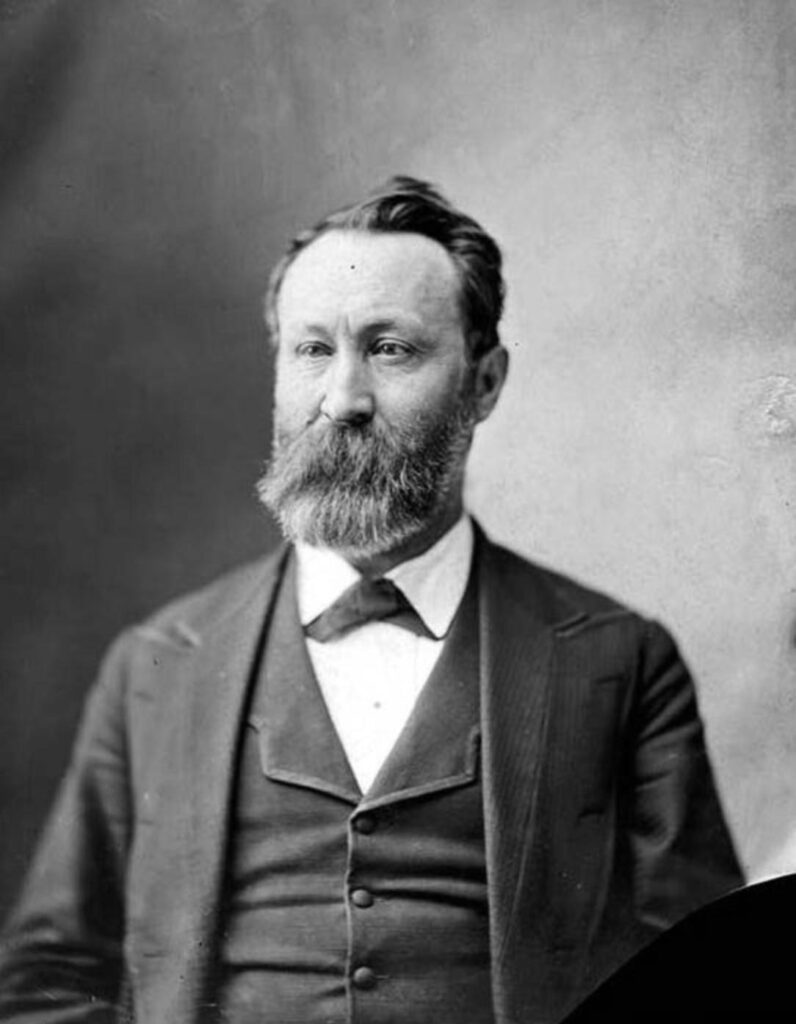
William McKendree Robbins
After the Civil War had ended, it still took time for the wounds to heal. Not so much the physical wounds but spiritual ones. The Gettysburg Battlefield was one of those wounds. Those soldiers who survived the battle had lost friends and comrades during the fighting. Some of them weren’t willing to forgive and forget.
But as they say, “Time heals all wounds,” and so it was with Gettysburg.
Major William McKendree Robbins was a native of North Carolina, but he had fought in the Civil War with the 4th Alabama Infantry. His unit had fought at Gettysburg and Robbins had been one of those survivors who lost friends to Union bullets. Robbins himself was wounded at the Wilderness along the Plank Road.
He had moved on with his life after the war. He was elected to the U.S. Congress in 1873 and he spent three terms representing North Carolina helping govern the country he had fought against.
In 1894, President Grover Cleveland appointed him to serve on the Gettysburg Battlefield Commission as the southern commissioner. Robbins had also been a strong proponent of reconciliation between the North and the South after the war, but not everyone was as supportive.
A year later, Robbins decided to join in the dedication of the 32nd Massachusetts Memorial as “a silent participant,” he wrote in his journal.
The 32nd Massachusetts Infantry had withstood a Confederate attack on July 2, 1863, east of Emmitsburg Road on the present-day Sickles Road. The unit had also fought later at the Wheatfield. All together 79 out of the 227 officers and men were killed or wounded.
The monument is a six-foot tall representation of a tent with a canteen hanging from the tent pole. The regiment’s information concerning the Battle of Gettysburg is inscribed on the side of the tent.
Robbins wrote that he attended “as seemed to be my official duty as a Commissioner. I joined in singing the patriotic songs. The veterans present were quite as friendly to me as if we had fought on the same side in the Civil War and I felt quite at ease among them.”
Not only had he been able to reconcile his feelings from the war, but so had the survivors of the 32nd Massachusetts. Not everyone felt that way.
Later in the day, Robbins rode over the battlefield with some of the survivors of the 32nd Massachusetts. As they talked, the Union veterans admitted that a minister in their group apparently did not have the spirit of forgiveness in him.
The Massachusetts men told Robbins that when the minister had learned that Robbins was a Confederate veteran, he said, “What does that rebel mean by making himself so free and familiar among us today?”
One of the veterans quickly replied, “Well, I guess he thinks the war is over.”
“We all had a good laugh together over the lingering prejudice of the preacher, the only man there who felt so,” Robbins wrote.
This small incident showed that the healing from the war had begun, though there was still some work to do.
Robbins remained on the commission until his death in 1905 and he did his part to help make sure that the Confederate story at Gettysburg was told.
“It was Robbins dream that the Confederates would memorialize the battlefield in much the way that their Union opponents had, but for a variety of reasons that never came to pass. On the battlefield today there is only one iron tablet dedicated to a Confederate regiment: that of the 4th Alabama on South Confederate Avenue, designed and paid for by Robbins,” according to the web site, Draw the Sword’s article, “Important People in the History of the Park.”