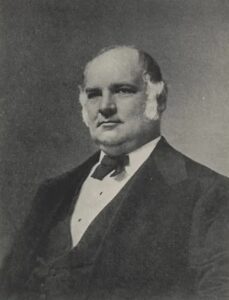
John W. Garrett
When the western end of Allegany County separated to form its own county in 1872, it became Maryland’s last county, both in terms of when it was formed and where it is moving east to west across the state.
For the name of this new county, residents chose Garrett, the surname of the man who had helped develop the region by expanding the Baltimore and Ohio Railroad into the region and beyond. However, John W. Garrett, president of the B&O Railroad, wasn’t even a resident of the county.
It was actually his expansion of the railroad that brought him to the area. Once the railroad opened to Oakland, the Deer Park Hotel opened the following year to capitalize on visitors who were discovering the beauty of the area. Shortly after that, Garrett had a summer home constructed in Mountain Lake Park. From that point on, he became a part-time resident of the county.
This lasted until his death. He died at his summer home on September 26, 1884, surviving his wife, who had died a year earlier.
“It has been expected for several days, but the change from the convalescent state, which all summer had been of such character as greatly to encourage his relatives and friends, was sudden,” The (Baltimore) Sun reported.
Garrett had arrived at his summer home in Deer Park in June and had been improving slowly as he enjoyed the county’s fresh, clean air. Dr. N. R. Gorter attended Garrett and was optimistic about his improvement.
Then things suddenly changed, and Garrett’s health quickly worsened. Two of his children — Thomas Harrison Garrett and Mary Elizabeth Garrett—were already in Deer Park. Mary Elizabeth was acting as a nurse and carrying out Dr. Gorter’s instructions for her father’s care. Robert was in New York, and when he received a telegram letting him know about his father’s condition, he rushed back to Deer Park.
By the time Robert arrived, his father was alive, but only semi-conscious. “He roused from the stupor several times and asked for his sons, but when they attempted to talk to him he was unable to carry on the conversation,” The Sun reported.
Finally, he passed into unconsciousness and was unable to eat or drink anything, but he still clung to life obstinately.
“He continued to sink with slight transitory phases of improvement until midnight, when his strength rallied as if for a final effort, encouraging the doctor to hope that he might survive some four or five hours later,” The Sun reported.
Garrett died at 5:25 a.m. on September 26. Besides his doctor and a medical attendant, his children, daughter-in-law, and sister were also at his bedside.
Arrangements were made for a special train to carry Garrett’s casket back to Baltimore in his private rail car, but when the casket wouldn’t fit through the doors of the car, it had to be placed in a baggage car.
The train engine was draped in black, and at the foot of the headlight a black sign with the words “At Rest” in gilt lettering was hung.
The train started on its 240-mile journey. Railroad workers lined the track along the way and removed their hats in respect for the former president of the Baltimore and Ohio Railroad.
Mayor Hopewell Hebb, members of the city council of Cumberland, and Judges Gordon and Hoffman met the train at the Queen City Hotel, where it stopped for half an hour so the train cars could be draped in mourning. Black cloth was attached to the sides of the cars with white rosettes. Judge Gordon, spokesman of the local party, expressed the sympathy of the people of Cumberland to Mr. Garrett’s family in their bereavement. He said Garrett’s death was a national loss.
“An opportunity was also given the employes of the road, including many of the workmen in the Cumberland rolling mill who had gathered in front of the hotel, to view the remains,” The Sun reported. “The upper portion of the casket was open, revealing Mr. Garrett’s face, and the men filed through the baggage-car, pausing an instant to look upon the well-known features. Mr. Garrett’s appearance was very natural and life-like. The expression of the face, the lower part of which is covered by a full white beard, is composed and tranquil.”
Before the train left, former Gov. Lloyd Lowndes sent a “handsome pillow of choice flowers” that was placed on the casket.
The train continued on to Baltimore, where a hearse met the train and carried it to Garrett’s home in preparation for the funeral the following day.
A week after Garrett’s death the Garrett County Commissioners passed a resolution concerning the county’s namesake, which read, in part, “Resolved, That as citizens of Garrett county, we deeply feel and will long and earnestly lament the loss we have sustained in the death of him whose honored name our county proudly bears.” It also stated that the with Garrett’s death, the county had “suffered a material loss which we apprehend will never be repaired.” All the public buildings in Oakland were draped in black for 30 days to mourn his passing.
Besides a Maryland county, other places were also named in honor of the long-time president of the B&O Railroad. This includes Garrett, Indiana; Garrett Island in the Susquehanna River in Maryland; Garrett Park in Montgomery County, Maryland; and Garrett, Pennsylvania.