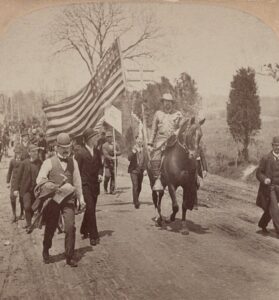
 They came as an army; not to conquer, but to have their voices heard.
They were a group of unemployed workers that formed in Massillon, Ohio, under the direction of Jacob Coxey. The official name of the group was the Commonweal of Christ, but most people referred to it as Coxey’s Army. The group planned to march to Washington D.C. where Coxey would present his petition to Congress of his ideas for a national program of building and repairing roads that would also solve the national unemployment problem. The group started its march with much fanfare, leaving Massillon on Easter Sunday, March 25, 1894, and made its way slowly eastward. Their mission inspired other groups to set out for Washington, and by the end of April, more than 7,000 men were marching toward Washington from different locations across the country.
“Stories of pillaging, disorderly conduct, and even assaults by the band of men all served to alarm the local residents and spread fear and apprehension as to what the impending invasion would bring. Some news accounts were reporting that the army was infested with drunks, crooks, and toughs,” Scott wrote. Harold Scott wrote in his book Incredible, Strange, Unusual…
While the actual situation was not that bad, the army did face deprivation and slow passage on the very roads they hoped to repair. Infighting over leadership of the group led to factions forming within it and even a mutiny as the two leaders vied for control of the army. Carl Browne, who had been appointed by Coxey to lead the group, was ousted from leadership and a group led by Unknown Smith took control for a short time. No one knew the man’s name, and he refused to give it to reporters, so they called him “Unknown Smith.” It took Coxey to restore Browne to his leadership role.
The group’s primary route was along the National Road, and on April 24, after a month of travel, Coxey’s Army prepared to invade Frederick County. The hundreds of men arrived at the Frederick County / Washington County line on the morning of April 24. They started down South Mountain and met Frederick County Sheriff Daniel Zimmerman and 30 mounted deputies at the county line around 9:30 a.m.
“The officers did not make any attempt to stop the army, but merely formed a line and preceded it toward the city of Frederick,” John A. Grant wrote in Coxey’s 38-Day March Through the Alleghenies in Search of Economic Justice.
Browne was traveling a half mile back from the front of the group when it reached the county line. When word reached him that the sheriff had been waiting for them, he rushed forward to deliver one of his “bombastic” speeches, only to find that the sheriff was leading them into Frederick.
Instead of criticizing the deputies, Browne said that “he felt much flattered by the fact that Frederick County had thought so much of the Commonweal as to send out such a handsome and well mounted reception committee,” according to Grant.
However, the other members of the army weren’t so happy to see the deputies. They cursed them and called them Pinkertons. Pinkertons were the private police and detectives that companies often hired for protection and strike breaking.
The army received a warm welcome in Frederick, which was unusual. For instance, they had passed through Middletown “without hurrah or harassment,” according to Grant.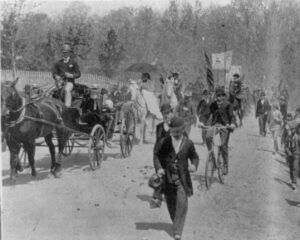
The Frederick drum corps met the army at the Frederick city line and led them into the town as residents stood on the sidewalks waving flags and cheering them.
Jacob Coxey met them at the Barbara Fritchie House. Though the group was named after Coxey, he rarely traveled with it. Instead, he traveled ahead and slept in rooms while the men who followed him were generally forced to sleep outside.
Coxey also had 35 new recruits and one old recruit who was rejoining the army with him. They called him Tooting John because he was a bugler.
The group then proceeded through Frederick. Coxey rode in his carriage, tipping his hat to people as they rode along to the baseball field.
There they set up Camp Lafayette and charged people 10 cents to see the camp. This is despite the fact they couldn’t erect a circus tent that they typically used. It had an undisclosed problem, but the Salvation Army opened its doors and allowed the men to sleep in their building.
That evening, Coxey and Browne gave speeches to try to inspire the men in the army and the spectators. Roy Kirk, a reporter traveling with the army, read a telegram to the crowd from Henry Vincent in Chicago. Vincent had just come from a meeting of the Iron Molders Union and promised to have 1,000 men join Coxey in Washington on April 29. This brought a cheer from the audience. A group of women gave Browne a bouquet that he mounted on a 4-foot wooden shaft.
“From that point onward, the reporters noted that a spirit of defiance seemed to pass through the Commonweal,” Grant wrote.
Meanwhile, there were rumors floating through Camp Lafayette that 1,200 militia had been called up in Washington, D.C. to protect the city against the army.
That evening, it was decided to change the army’s route. They had planned to travel further east toward Baltimore and then turn south at Ridgeville to go to Rockville. The route was altered to head directly to Rockville. This meant that Hyattstown and Gaithersburg would find themselves hosting the army. This did not set well with Gaithersburg, who started forming a minuteman group to protect property in the town.
 On the morning of April 26, the men in the army ate breakfast, packed up, and formed into marching group. They headed out of Frederick at 8 a.m. once again led by the sheriff and his deputies. The Independent Fife and Drum Corps played them off with “Maryland, My Maryland.”
From Frederick, the group was able to meet their deadline date to get to Washington, where thousands of people lined the streets to watch them march through the city. However, things still did not go smoothly.
“Before the marchers could present their petition, the police rushed them, and Coxey and the other leaders were arrested for trampling on the grass,” Scott wrote.
Though the group failed that day, what they sought to achieve resonated with the public. Fifty years later, Coxey was finally able to read his speech from the Capitol steps. Grant also noted that many of Coxey’s ideas became part of President Franklin Delano Roosevelt’s New Deal Programs.